
La santé mentale au travail est devenue un enjeu structurant pour les entreprises.
84 % des Français considèrent aujourd’hui la santé mentale aussi importante que la santé physique (source : Mercer x CRAPS 2025).
41 % des salariés français déclarent avoir déjà connu un burn-out ou un état d’épuisement professionnel selon l’enquête Great Insights 2026.
Ces chiffres traduisent une réalité désormais incontournable : la santé mentale influence à la fois l’expérience individuelle du salarié (se sentir bien, fonctionner durablement et se développer) et la performance globale de l’entreprise (assurer la performance, l’engagement, un climat social sain et le respect des obligations).
Elle interroge directement la capacité des entreprises à :
- prévenir les risques psychosociaux,
- détecter les signaux faibles,
- accompagner les collectifs avant que les situations ne se dégradent,
- et proposer des réponses adaptées lorsque les troubles sont déjà installés
Face à ces enjeux, la direction RH a son rôle à jouer.
S’appuyer sur des outils pour améliorer la santé au travail
Face à l’augmentation des enjeux liés au stress au travail, au burn-out et aux risques psychosociaux, de nombreuses solutions de santé mentale au travail ont émergé ces dernières années.
Plateformes d’écoute psychologique, solutions de diagnostic, outils de sensibilisation, accompagnement managérial, prévention des RPS, coaching… les offres se multiplient et il n’est pas toujours évident pour les entreprises d’identifier les solutions réellement adaptées à leurs besoins.
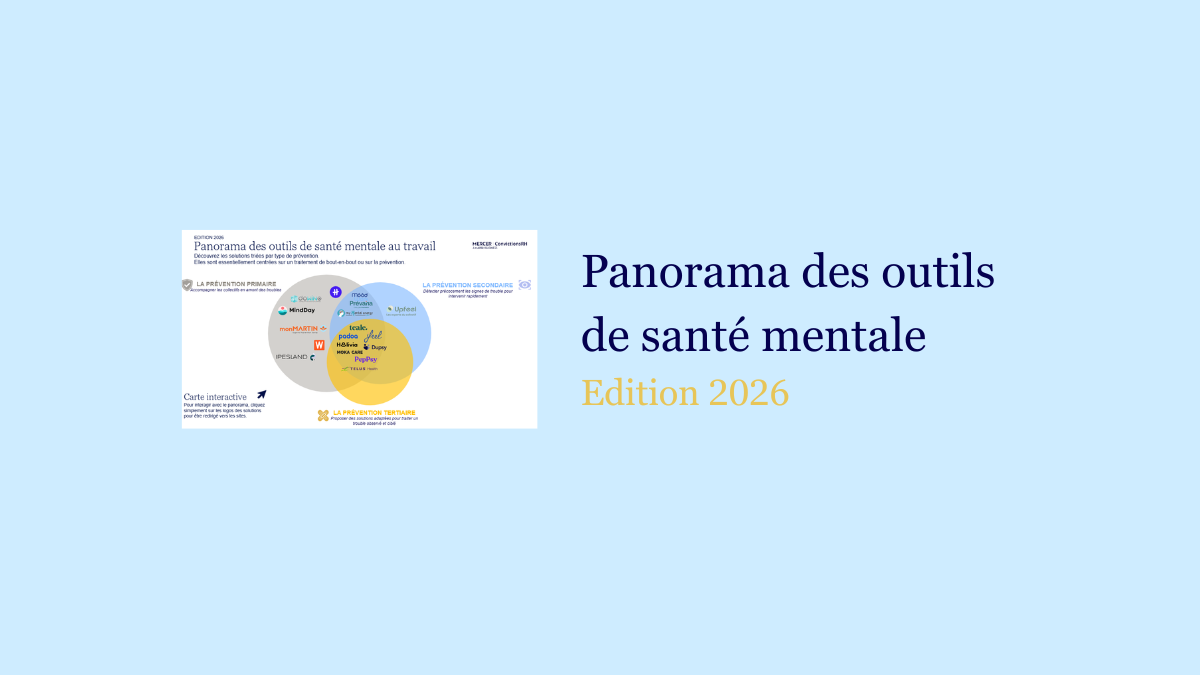
C’est pourquoi nous publions la 2e édition de notre panorama des solutions de santé mentale au travail, un outil conçu pour vous donner une meilleure vision du marché.
Un panorama des solutions de santé mentale structuré selon 3 niveaux de prévention
L’objectif de ce panorama est d’aider les DRH, responsables QVCT, RRH, responsables santé au travail et directions d’entreprise à :
- mieux comprendre le marché des outils de santé mentale
- identifier les grandes catégories de solutions,
- identifier des solutions qui pourraient répondre à leurs besoins
Nous avons ainsi référencé les solutions identifiées selon les 3 grands niveaux de prévention :
- Prévention primaire : sensibiliser à la santé au travail et promouvoir un environnement propice à la bonne santé des équipes
- Prévention secondaire : traiter les potentiels troubles dès que les prémices se font sentir (nombreux arrêts de travail, bruits de couloir)
- Prévention tertiaire : limiter les conséquences d’un trouble déjà installé et rétablir l’équilibre de l’organisation
Comment choisir le bon outil ?
Nous vous accompagnons dans le choix et le déploiement de l’outil qui correspond le mieux à vos besoins.
Notre démarche se déroule en 3 étapes clés :
- Cadrage & recueil des besoins (benchmark, priorisation de vos critères, cadrage de la démarche etc.)
- Cahier des charges et identifications éditeurs (rédaction du cahier, identification des éditeurs, validation avec les métiers)
- Processus de sélection de l’outil et déploiement (évaluation des éditeurs, recommandations, appui au déploiement)
Et parce que notre accompagnement ne se limite pas aux réflexions « outils », nous vous accompagnons également dans l’analyse, la structuration et le déploiement de votre feuille de route globale en faveur de la santé au travail.
Notre objectif à vos côtés est simple : faire de la santé, sécurité et du bien-être au travail un levier collectif de performance et d’engagement.
Vous souhaitez en discuter ? Contactez nous
Je télécharge le panorama des outils de santé mentale au travail
Vous souhaitez échanger sur votre politique santé mentale ou en savoir plus sur chaque outil ?

Marine Chabot
Associée

Cette étude pourrait vous intéresser
Découvrez le baromètre santé mentale 2026 publié par Mercer.